Samsung Galaxy Z Tri-Fold to launch this week with three batteries

Samsung has previously both hinted at and confirmed that its first triple-folding smartphone will launch this year. However, the Samsung Galaxy Z Tri-Fold still doesn’t have an official release date.

According to a new report in the Korea Herald, however, the deal is set to take place this week at the 2025 Asia-Pacific Economic Cooperation (APEC) summit. The summit will take place from October 31 to November 1 in Gyeongju, South Korea.


Samsung has not yet decided on a product name for its triple-folding device. Rumors suggest it could be called the Samsung Galaxy Z Tri-Fold or Galaxy G Fold. Availability of the device will be extremely limited, as Samsung reportedly only plans to produce 50,000 to 200,000 units in the initial production phase.
Samsung Galaxy Z Tri-Fold: Patent documents show three batteries
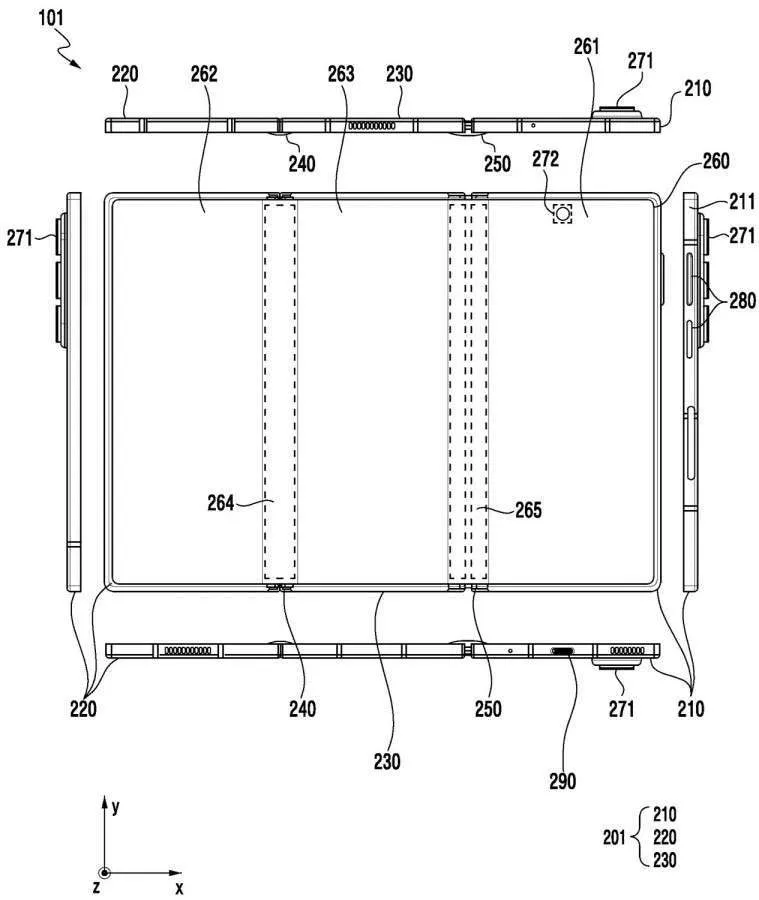
In addition, a patent document has surfaced showing the Samsung Galaxy Z Tri-Fold with three batteries. Since it is a triple-folding smartphone, it consists of three segments, each housing a battery cell. The diagram below, included in the patent document, shows that the smallest battery (T1) is located in the segment with the three cameras on the back, while the second largest battery (T3) is located in the segment with the display.
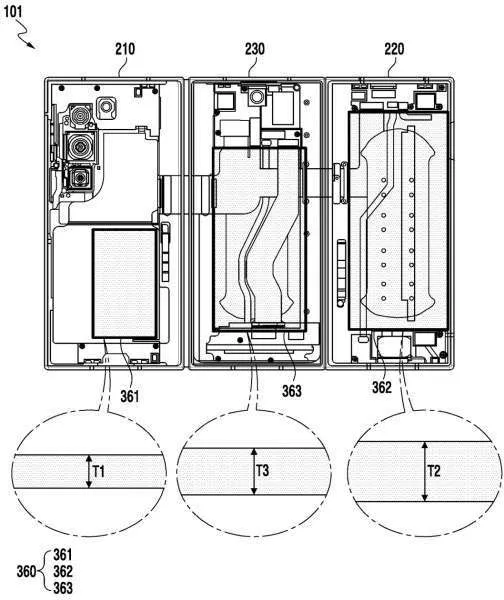
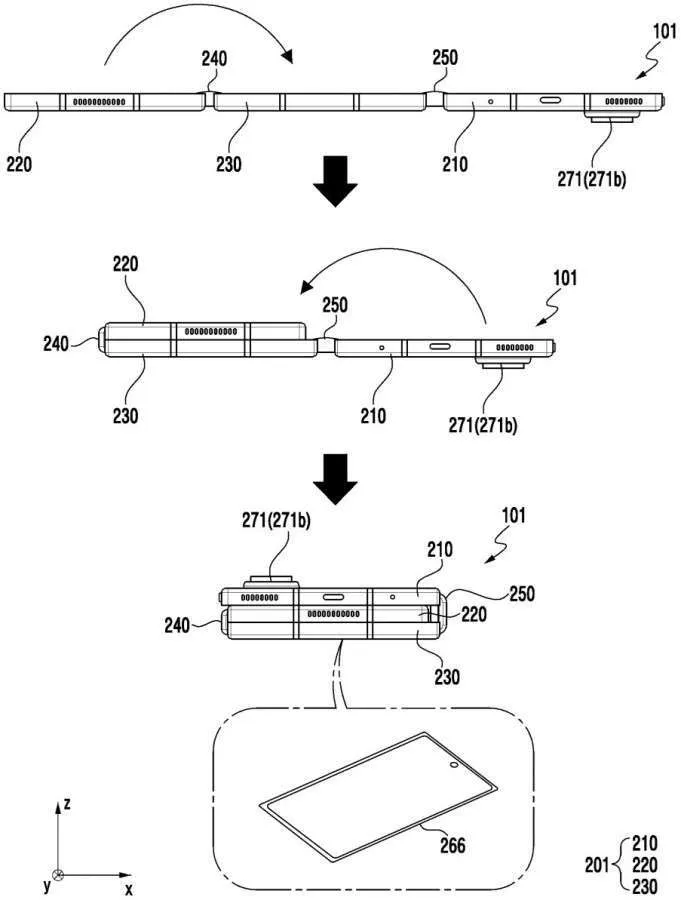
The largest battery (T2) is located in the segment that lies between the other two when the TriFold is folded and does not need to accommodate cameras on the back or a second display on the back.
The document doesn’t provide any information on the individual or total battery capacity or charging speed. Hopefully, it will be more than the Galaxy Z Fold7, which, with a tiny 4,400 mAh battery and Samsung’s typical 25W cable charging, is extremely underpowered compared to the competition.
With a rumored launch price of $2,800 (€2,404), the Samsung Galaxy Z Tri-Fold would be almost exactly $1,000 more expensive than the Galaxy Z Fold7. According to previous reports, it will only be available in a few select markets, including China, South Korea, the US, and the UAE. The new Samsung Exynos 2600 chipset could provide the power. Its main rival will be the Huawei Mate XT.


