Apple MacBook Pro OLED with touch display is here

Apple today unveiled a new high-end MacBook Pro, available in 14-inch and 16-inch sizes. The new device features a PROLED XDR display with touch gesture control and an illuminated Apple logo on the back. Prices for the Apple MacBook Pro OLED start at €3,299/$2,899 for the 14-inch model and €3,899/$3,399 for the 16-inch model.
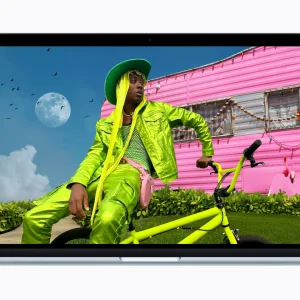
According to the manufacturer, the Apple MacBook Pro OLED offers the “world’s best display in a professional laptop.” The PROLED display uses tandem OLED technology in combination with advanced algorithms in the display engine and factory calibration for “exceptional brightness, impressive contrast, and vivid, true-to-life colors.”


The display offers a peak brightness of up to 2000 nits in both HDR and SDR modes, as well as a contrast ratio of 10,000,000:1. A display processor controls the color and brightness of each individual pixel, adapting the display to the content, temperature, ambient light, and pixel usage. ProMotion technology is available with refresh rates from 10 Hz to 120 Hz. An anti-reflective coating reduces reflections in bright light. The new MacBook Pro is also optionally available with a nanotexture display.
The touch sensor is integrated directly into the Apple MacBook Pro OLED display, eliminating any lag. According to Apple, the touch operation feels “incredibly responsive and precise.” Users can scroll through web pages with a swipe, zoom in on photos by pinching, drag and drop slides from one presentation to another, and double-tap to open a window in full-screen mode.
A new hinge design provides greater stability for touch operation, and improved video stabilization smooths the camera image during video calls with touch controls. According to Apple, macOS automatically converts touch inputs into clicks, so many existing apps work with touch right away.
The Apple MacBook Pro OLED is up to 1 mm thinner than its predecessor and significantly lighter, weighing just 1.4 kg for the 14-inch model and 1.8 kg for the 16-inch model. The notch is gone; instead, Apple has integrated a small, space-saving Dynamic Island. This Dynamic Island houses Spotlight, Live Activities, and Siri AI. As with the iPhone, it allows quick access to and use of important information.
Thanks to narrower bezels, the display of the 16-inch MacBook Pro now measures 16.3 inches, while that of the 14-inch MacBook Pro is now 14.2 inches.
The new Apple MacBook Pro OLED uses the same M5 Pro and M5 Max chips as the MacBook Pro models introduced in March, but features a redesigned heat dissipation system that directs warm air away from the display. It supports up to 128GB of RAM and is equipped with a new six-speaker system that delivers 50 percent deeper bass.
There are three Thunderbolt 5 ports, HDMI, an SDXC card slot, MagSafe, and a headphone jack. The new devices support up to four external displays and are equipped with Wi-Fi 7 and Bluetooth 6. Thanks to fast charging, the MacBook Pro can be charged to 50 percent in 30 minutes, and up to 16 TB of storage is available.
Apple MacBook Pro OLED Dynamic Island
Apple today introduced Dynamic Island on the Mac for the first time with its new 14-inch and 16-inch MacBook Pro models. This feature combines Live Activities, Spotlight, and Siri AI into an interactive area of the display.
The Dynamic Island was first introduced in September 2022 with the iPhone 14 Pro and iPhone 14 Pro Max. It replaced the notch with a smaller TrueDepth camera cutout surrounded by software that expands and changes shape to display notifications, live activity, and controls.

The Apple MacBook Pro OLED adopts the concept of keeping ongoing activities visible and accessible while users use other apps. According to Apple, users can, for example, answer calls, control music playback, and receive AirDrop requests via the interface. The dynamic island also serves as a platform for Spotlight and Siri AI.
The touchscreen of the new Apple MacBook Pro OLED allows actions such as pausing a song to be performed simply by tapping.
While the original iPhone used the TrueDepth camera system for Face ID, the new MacBook Pro continues to use Touch ID for authentication and features a 12-megapixel camera in the center. Therefore, the introduction of Dynamic Island does not bring Face ID to the Mac.
Apple MacBook Pro OLED with deeper bass and better sound with the lid closed
The new Apple MacBook Pro OLED 14-inch and 16-inch models feature an improved six-speaker sound system with redesigned woofers and tweeters, as well as special audio tuning for use with the lid closed.

According to Apple, the new woofer design delivers 50% deeper bass, while redesigned tweeters improve sound clarity through optimized sound dispersion. The Apple MacBook Pro OLED also continues to support spatial audio with Dolby Atmos.
For the first time, Apple has also added a special audio tuning for use with the lid closed. According to the company, this improves sound quality when the MacBook Pro is connected to an external display, allowing users to continue using the built-in speakers in desktop mode.
Apple MacBook Pro OLED offers up to 16 TB of storage
The new Apple MacBook Pro OLED models with touchscreens offer up to 16 TB of internal storage, doubling the maximum storage capacity of the previous generation from 8 TB. This additional capacity comes at a price. Upgrading the top-of-the-line M5 Max configuration from the standard 2 TB SSD to 16 TB costs $7,000, making it $4,000 more expensive than the $3,000 upgrade to 8 TB.
Battery life
Despite the switch to a new OLED display and touch functionality, the Apple MacBook Pro OLED models still offer a battery life of up to 24 hours. Both the 14-inch and 16-inch PROLED and mini-LED MacBook Pro models offer the same maximum battery life.

- 16-inch, M5 Max – Up to 22 hours of video streaming, up to 16 hours of web streaming
- 16-inch, M5 Pro – Up to 24 hours of video streaming, up to 17 hours of web browsing
- 14-inch, M5 Max – Up to 20 hours of video streaming, up to 13 hours of web streaming
- 14-inch, M5 Pro – Up to 22 hours of video streaming, up to 14 hours of web browsing
The Mini-LED and PROLED models are equipped with the same M5 Pro and M5 Max chips, so the main difference lies in the display. The higher efficiency of the OLED display likely compensates for the power consumption caused by the touch integration. The 14-inch PROLED and Mini-LED models have a 72.4-watt-hour battery, while the 16-inch models have a 100-watt-hour battery.
John Ternus on the Apple MacBook Pro OLED
In an interview with Wired, Apple’s new CEO, John Ternus, explained Apple’s reasoning behind the MacBook Pro’s new touch features. Despite the additional touchscreen, Apple still considers the MacBook Pro a device that allows for indirect input.

“The Mac is primarily an indirect input device based on the trackpad and keyboard. However, I think there are situations where touch input is comfortable and practical.”
We had to reach a point where the touch functionality didn’t compromise the product in any way. It didn’t make it heavier or thicker. We achieved this by combining it with the OLED screen, the best display we’ve ever put in a Mac. And of course, it also has a touch function.
John Ternus, Apple CEO
Apple had previously stated that it would not merge its iPad and Mac product lines because they served two different functions. Hardware chief Johny Srouji and marketing chief Greg Joswiak were also interviewed. Srouji explained to Wired that display technology, Apple’s silicon chips, and software had advanced to the point where they met Apple’s requirements for touch integration.
Joswiak explained that professional users had been waiting for touch functionality, and a generation of young creatives expected this feature. Apple’s version of a touchscreen laptop features improved heat dissipation to prevent the display from overheating, an anti-reflective coating that Apple says requires no more frequent cleaning than a standard display, and a reinforced hinge that keeps the screen stable when touched.
Apple MacBook Pro OLED costs up to $14,549
The new Apple MacBook Pro OLED models with touchscreen start at €3,299/$2,899 for the 14-inch version and €3,899/$3,399 for the 16-inch version. However, if you select all available upgrades, you quickly find yourself in a completely different price range, with prices well over $14,000.
The starting configurations and US prices are as follows:
- 14-inch MacBook Pro with M5 Pro: $2,899 with 15-core CPU, 16-core GPU, 24 GB RAM and 1 TB SSD, compared to $2,499.
- 16-inch MacBook Pro with M5 Pro: $3,399 with 18-core CPU, 20-core GPU, 24 GB RAM and 1 TB SSD, compared to $2,999.
- 14-inch MacBook Pro with M5 Max: $4,499 with 18-core CPU, 32-core GPU, 36 GB RAM and 2 TB SSD, compared to $4,099.
- 16-inch MacBook Pro with M5 Max: $4,799 with 18-core CPU, 32-core GPU, 36 GB RAM and 2 TB SSD, compared to $4,399.
The $400 price increase represents a roughly 16% rise for the 14-inch entry-level M5 Pro and 13% for its 16-inch counterpart. The M5 Max models will increase in price by approximately 10% and 9%, respectively. These price increases are based on the prices of the previous models without touchscreens immediately prior to today’s announcement, not their lower launch prices before Apple’s price hikes.
At the other end of the price range, Apple’s configurator allows the 14-inch MacBook Pro with touchscreen to cost up to $14,249 and the 16-inch model up to $14,549. Both configurations include the high-end M5 Max chip with an 18-core CPU and 40-core GPU, 128 GB of RAM, a 16 TB SSD, and nano-texture glass.
Storage capacity accounts for a large portion of the configuration costs. On the top-of-the-line M5 Max configuration, upgrading the standard 2TB SSD to 4TB costs $1,000, to 8TB $3,000, and the new 16TB option $7,000. Switching from 48GB to 128GB of RAM adds another $2,000, while nano-textured glass costs $150.
The previous 16-inch MacBook Pro, equipped with 128GB of RAM, an 8TB SSD, and nano-texture glass, cost a maximum of $10,149. The new Apple MacBook Pro OLED, at a maximum of $14,549, is a hefty $4,400 more expensive, representing an increase of approximately 43%. However, it also offers double the storage capacity. With the same 8TB SSD configuration, the new 16-inch model costs $10,549, which is $400 more.


The new Apple MacBook Pro OLED models will be offered alongside the existing Mini-LED models and the new 14-inch MacBook Pro with the M6 chip. Pre-orders are available now, and sales begin on Friday, November 6.


